You're not going to believe this, but turns out you can't always take criminals at their word. Actually, I'll walk that back a bit as it may not even be the cybercrime guys who got this wrong, but it all starts here:
🚨Cyber Alert ‼️🇺🇸US - 𝗖𝗮𝗿𝗵𝗮𝗿𝘁𝘁ShinyHunters hacking group claims to have compromised Carhartt and allegedly stolen more than 50 GB of compressed data containing millions of customer records, employee information, customer metadata, loyalty-related information, and… pic.twitter.com/BvzsEQS54l
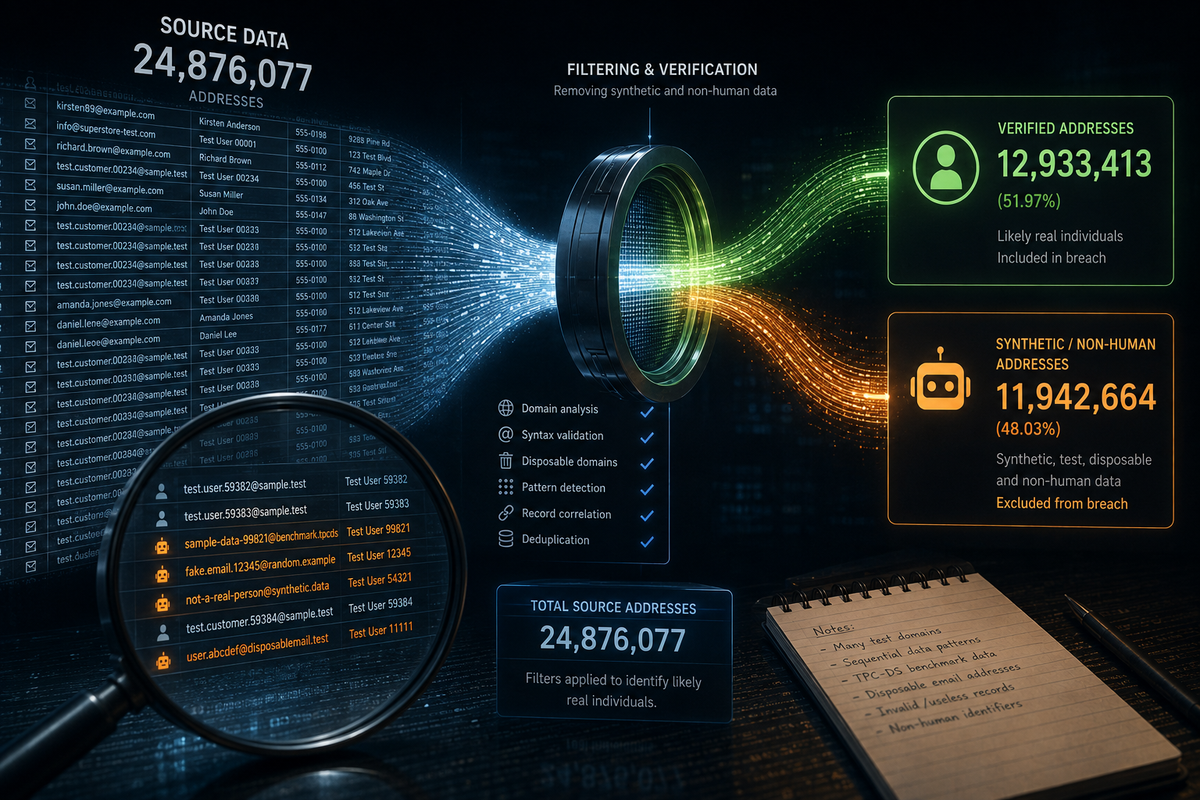
My usual Have I Been Pwned (HIBP) workflow after a breach emerges is to run our open source Email Address Extractor tool over the corpus of data, get a count of the unique addresses then drop it into the processing pipeline. Having a count helps prioritise: it's roughly the same effort to process a breach with 10M addresses in it as it is 100k addresses, but we obviously reach 100x more people with the larger corpus so that goes first. So, following the release of the Carhartt data above, I ran the tool and got 24,876,077 addresses. That's a biggy, let's dive in.
One of the first things I do when analysing a breach is look for news and industry commentary. Once you get through all the results for class actions (ugh), you usually find various other services and news sites reporting on the incident. One such example (which I won't name, because they're wrong) cited a very similar number to my initial pass, which at face value, reinforced my thinking. But here's where it all takes a turn because, inevitably, this is where the other analysts stopped...
I've been using OpenClaw pretty extensively this year to help with a number of tasks, including breach analysis. Here's how I normally begin (timestamps are AEST and yes, I called it "PwnedClaw"):
This article was aggregated automatically by CyberWire Daily's newsfeed engine. Original reporting: www.troyhunt.com.